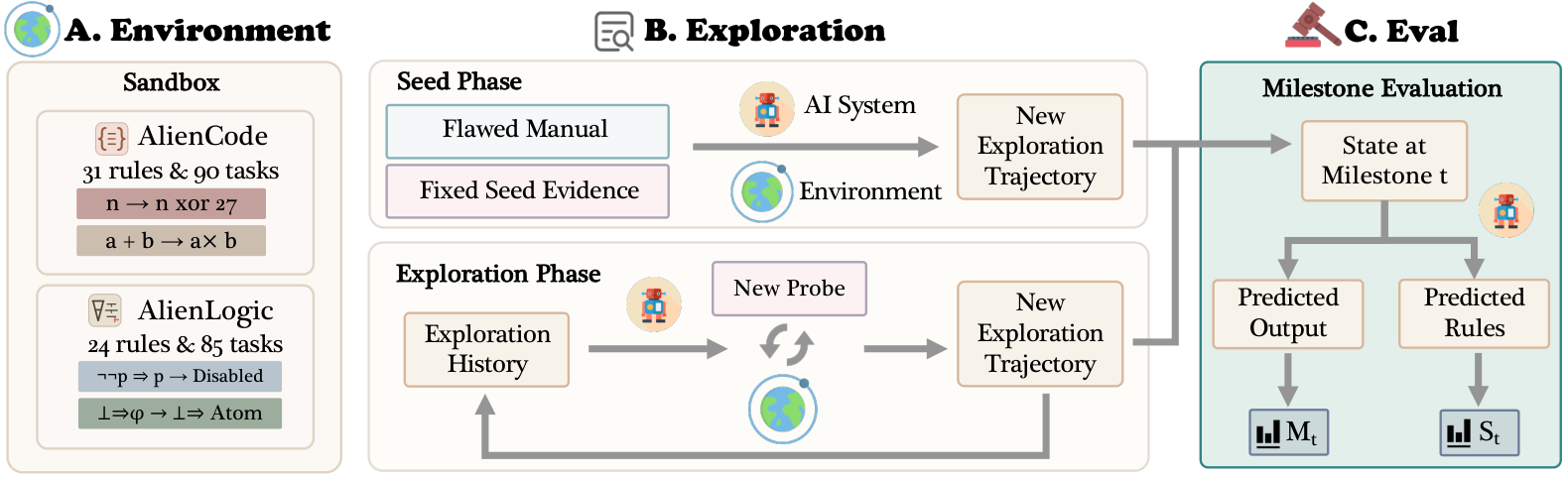
Two executable worlds whose rules contradict everything a model has read.
An interpreter and a proof checker hold the ground truth, so every answer
can be checked.
The two standard ways of testing it each fail, for a different reason.
Contamination
Known domains are already known
A correct answer may simply have been memorised, and contamination cannot be ruled out for a black-box model.
both / or
Verification
New claims cannot be graded
Without a reliable verifier, a real discovery and a confident mistake look identical.
The construction
New to the system, fully known to the evaluator.
SHATTER looks destructive and multiplies. EMIT(100) prints
127. Nothing in the language adds. The rules were written for this
benchmark, so no model has read them, and they are executable, so the
evaluator can check every held-out answer against them.
The sandboxes
AlienCode and AlienLogic.
Both are deterministic and executable. Every active rule has at least one held-out
task that depends on it.
AlienCode
program synthesis · interpreter-graded
A calculation language whose familiar-looking operators follow hidden semantics.
Programs are run on private inputs, so passing takes rule-aware behaviour rather
than memorised examples.
31
hidden rules
90
held-out tasks
5
private inputs / task
AlienLogic
formal proof · checker-verified
A Fitch-style natural-deduction system with patched inference rules and opaque
identifiers. A checker verifies every proof, and unprovable goals earn credit
only for a correct refusal.
24
patched rules
85
held-out theorems
21
unprovable goals
Probing
Every rule has to be found by probing.
The manual describes standard semantics, and the world was perturbed
underneath it. Pick a probe.
Explore with the world open. Answer with it closed.
Weights never change. Everything learned lives in one context window, and every
held-out answer is produced with the sandbox closed.
Six matched conditions · filled markers receive feedback
Leaderboard
Retained gain under autonomous exploration.
M0 after the seed, M4 after four rounds, gain
G = M4 − M0. Each cell is the mean of three runs.
held-out accuracy, percent
Reasoning labels name each provider's highest setting, not a common compute
scale. The last column is diagnostic and never enters G. Rank is by
M4.
RQ2 · Finding 3 · how the gain builds
How the gain accumulates across four rounds.
Fifteen pairs climb to the endpoint, three saturate early, one peaks and falls
back, one never moves.
shape
Six findings
Results across twenty system–sandbox pairs.
Does exploration work, where does it stall, and what does a unit of budget buy?
RQ1 · Findings 1–2 · which mode of exploration
Comparing five exploration modes at matched budget.
Each bar is a median difference across twenty pairs; the dots count how many came
out positive.
median Δ of retained gain
RQ2 · Finding 4 · where exploration stalls
How far autonomous runs sit from the oracle.
Against an arm that is simply handed the rules, AlienLogic runs sit 45.5 pp below
a near-perfect endpoint. AlienCode runs nearly reach one that is only 69.8%.
autonomous M₄ vs. rules disclosed
Stating a rule raises the pass rate on the tasks it governs by 39.1 pp — and still
leaves 14.8% failing.
RQ3 · Findings 5–6 · what a budget buys
Recovering a rule is cheap. Making it run is not.
The protocol rations what a system may ask of the world, never what it may think,
so cost splits into two currencies that disagree on size.
median gain efficiency, by world
AlienCode · what predicts retained gain
Throughput buys chances to learn a rule without delivering one.
From the paper
Figures from the paper.
The paper's own plots, re-rendered from the same scripts. Numbering follows the
PDF; click any figure to enlarge.
Paper
ExplorationBench: Measuring AI Systems' Exploration in Verifiable Alien Worlds
The construction is not specific to exploration: any ability confounded by
pre-training, but verifiable in an unfamiliar world, can be measured this way.
@article{zhang2026explorationbench,
title = {ExplorationBench: Measuring AI Systems' Exploration
in Verifiable Alien Worlds},
author = {Zhang, Ming and Xiang, Zhenghao and Shen, Yujiong and
Wang, Yuhui and Yue, Zhonghan and Dou, Shihan and
Yin, Zhangyue and Ye, Junjie and Liu, Shichun and
Zheng, Weihuang and Chen, Jiahao and Chen, Jiayi and
Liu, Hongzhang and Shao, Jiaqi and Pan, Maxm and
Gui, Tao and Zhang, Qi and Huang, Xuanjing},
journal = {arXiv preprint},
year = {2026}
}